Talk to SciX
Contact SciX to discuss climate indices, index requirements or disciplined customization.



Excerpt from Does Climate Ambition Always Create Risk Biases? To download the full article free of charge, please submit the form below
In the first episode of our Risk Management Series, we illustrated the benefits of using a factor risk model when constructing climate-aware indices—as opposed to a conventional ‘tilting’ approach—in order to control tracking error in live portfolios and improve efficiency.
Yet what about other risk biases beyond tracking error alone? In Episode 2, we consider this crucial follow-up question, including sector or regional deviations that can be created when constructing a climate-aware strategy, even when tracking error is properly managed ex-ante. We also consider the question of turnover, since ‘risk model’ approaches may naturally tend to incur higher turnover (and therefore implementation cost) versus ‘tilting’ methodologies.
Key takeaways
Future episodes of our Risk Management Series will compare different risk models, including approaches based on the management of active share, and their ability to support an index construction process.
The pursuit of a climate objective can generate unintended sector and regional deviations relative to the benchmark, if they are not explicitly controlled in the design of the strategy. For instance, an investor trying to decarbonize its portfolio, whether by screening or underweighting carbon intensive companies, will typically underweight carbon-intensive sectors and countries.
Exhibit 1: Average sector deviations relative to the benchmark
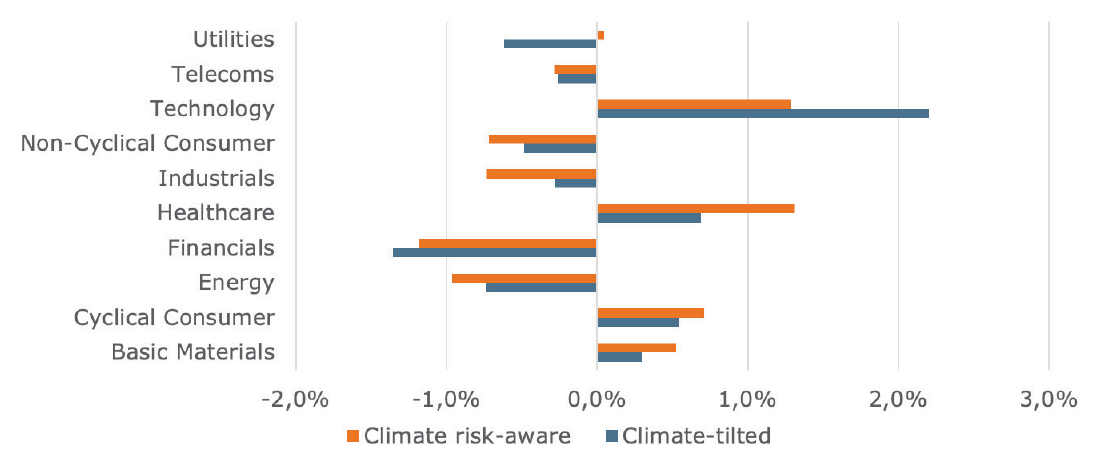
Exhibits 1 and 2 illustrate these consequences by showing the sector and regional allocation deviations implied by two contrasting climate-aware strategies discussed in the previous episode in this series. As a recap, both are designed to reduce climate physical loss relative to the benchmark with an ex-ante annual tracking error budget of 0.5%; the ‘climate-tilted’ strategy uses the portfolio tilting approach, while the ‘climate risk-aware’ strategy relies on the SciX risk model.
Exhibit 2: Average regional deviations relative to the benchmark
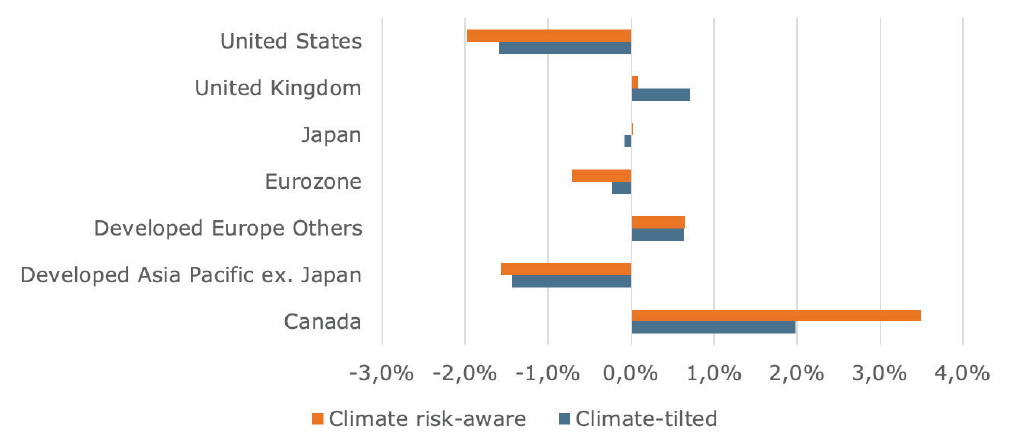
We see that both strategies have sector deviations ranging from -1.35% to 2.20% for the climate-tilted strategy and from -1.18% to 1.31% for the climate risk-aware strategy. The regional deviations range from -1.59% to 1.98% for the climate-tilted strategy and from -1.97% to 3.49% for the climate risk-aware strategy. The magnitude and stability of sector and regional deviations depend on the construction of the climate score and how often it is updated.
Exhibit 3 then provides a concrete illustration of the impact that sector or regional deviations can have on the short-term performance of climate-aware strategies. For this example, we focus on sector deviations and the first quarter of 2025. This quarter was characterized by a significant underperformance of technology stocks. At the beginning of the quarter, the climate-tilted strategy was overweight in the Technology sector by +3.6%. This led to an underperformance of the strategy of -0.53%, of which -0.32% came from the allocation to the Technology sector itself.
Exhibit 3: Climate-tilted strategy, relative sector allocation and Brinson performance attribution
| Sector | Relative sector allocation | Brinson performance attribution | ||
|---|---|---|---|---|
| Allocation | Selection | Total | ||
| Basic Materials | -0.01% | 0.00% | 0.04% | 0.04% |
| Cyclical Consumer | 0.23% | -0.02% | 0.06% | 0.04% |
| Energy | -0.60% | -0.07% | 0.00% | -0.07% |
| Financials | -1.61% | -0.11% | -0.03% | -0.14% |
| Healthcare | 0.23% | 0.02% | -0.01% | 0.01% |
| Industrials | -0.65% | -0.03% | 0.05% | 0.03% |
| Non-Cyclical Consumer | -0.47% | -0.02% | -0.01% | -0.03% |
| Technology | 3.60% | -0.32% | -0.03% | -0.35% |
| Telecoms | -0.12% | -0.01% | 0.00% | -0.01% |
| Utilities | -0.61% | -0.04% | 0.00% | -0.04% |
| Total | -0.59% | 0.06% | -0.53% | |
Of course, there are other cases in which this overallocation to technology stocks would have paid off. Nonetheless, it is important for investors to understand that leaving sector and regional allocations uncontrolled has consequences for the short-term performance of their climate investments. Hence, whether or not to control sector and regional allocations is a fiduciary decision for the investor.
Yet how can investors actually control for these biases and overall augment their set of risk management objectives?
It is evidently difficult to manage a variety of risks within tilting methodologies: for example, using simple heuristics, it is possible to adjust a climate score to control either sector or regional deviations, but not both simultaneously. Moreover, it is not possible to control the turnover of a strategy ex-ante. Turnover can only be observed ex-post in the backtest or in the historic track-record of the live portfolio. By contrast, risk model frameworks can accommodate additional risk management constraints, such as sector and regional control and turnover limits.
Climate ambition is never free, but its hidden costs can vary: a risk model methodology lets investors implement transparent risk management controls, fully consume their risk budgets and control for sectors, regions and turnover. In our analysis, climate risk-aware strategies reduced physical climate loss by 24–29% relative to the benchmark, versus 11–13% for climate-tilted strategies.
This was an excerpt from Does Climate Ambition Always Create Risk Biases? To read the full article, download your free PDF copy via the form below.

"*" indicates required fields