Talk to SciX
Contact SciX to discuss climate indices, index requirements or disciplined customization.



Excerpt from Five Problems with PAB Climate Indices (Climate Mitigation Series Episode 1). To download the full article free of charge, please submit the form below.
Amid widespread criticism of Paris-Aligned Benchmarks (PAB) from investors, advisors and index providers, new generations and iterations of climate mitigation indices have emerged. Before evaluating the potential strengths and weaknesses of both newer PAB products and non-PAB indices, it is first worth reviewing the reasons why PAB-based products have attracted growing disapproval since they first emerged in 2020.
In this first episode of SciX Insights’ Climate Mitigation Series, we therefore consider five key concerns surrounding PAB products and ask why they may have disappointed investors both financially and extra-financially.
Key takeaways
In the face of these challenges, investors might wonder: are the problems inextricably linked to the PAB regulatory framework or do they reflect specific implementation decisions taken by index providers? Naturally, there are differences between PAB products: a specific undesirable outcome in one PAB index would not necessarily have been experienced to the same degree in all PAB indices. Yet, taken as a whole, we believe that these criticisms are exceptionally difficult to rebut. Indeed, an implementation tweak that mitigates one concern may only worsen another.
The more useful question, perhaps, is whether a climate index (whatever its label!) actually allows investors to pursue credible climate objectives while retaining appropriate control over the financial consequences.
Paris-Aligned Benchmarks were designed by European regulators to make climate mitigation investing more transparent and more demanding. By attempting to translate the objectives of the 2015 Paris Agreement into measurable portfolio requirements, they offered investors a common framework and a regulatory standard so that products could be accurately labelled. This work led to the launch of the first EU-compliant PAB index in 2020, with the support of a consortium of French institutional investors. PAB indices gained momentum in 2021-2023, reaching EUR 116bn of assets under indexation.
The proposition appeared to make a great deal of sense at the time: PABs would immediately deliver an equity allocation with a substantially lower carbon footprint, a predefined decarbonization trajectory and safeguards to ensure the most carbon-intensive parts of the economy remained invested and therefore financed.
The regulation required PAB-labelled indices to satisfy several criteria. They had to:
The same regulation also established Climate Transition Benchmarks (CTB), which are broadly similar in terms of constraints albeit with a lower mandated reduction in overall GHG intensity (-30% rather than -50%) and no prescriptive fossil fuel exclusions.
The requirement that PAB indices be at least 50% less carbon intensive than the investable universe at all times introduces a relative test that may appear unhelpfully arbitrary. The rule somehow treats a lower footprint than the market as a strictly necessary condition for alignment without assessing the market’s own decarbonization. In principle, the rule could become increasingly irrelevant and restrictive if the overall market itself delivers emissions reductions. Moreover, it could create questionable incentives for corporations that are successfully transitioning but that happen to belong to a highly emitting sector.
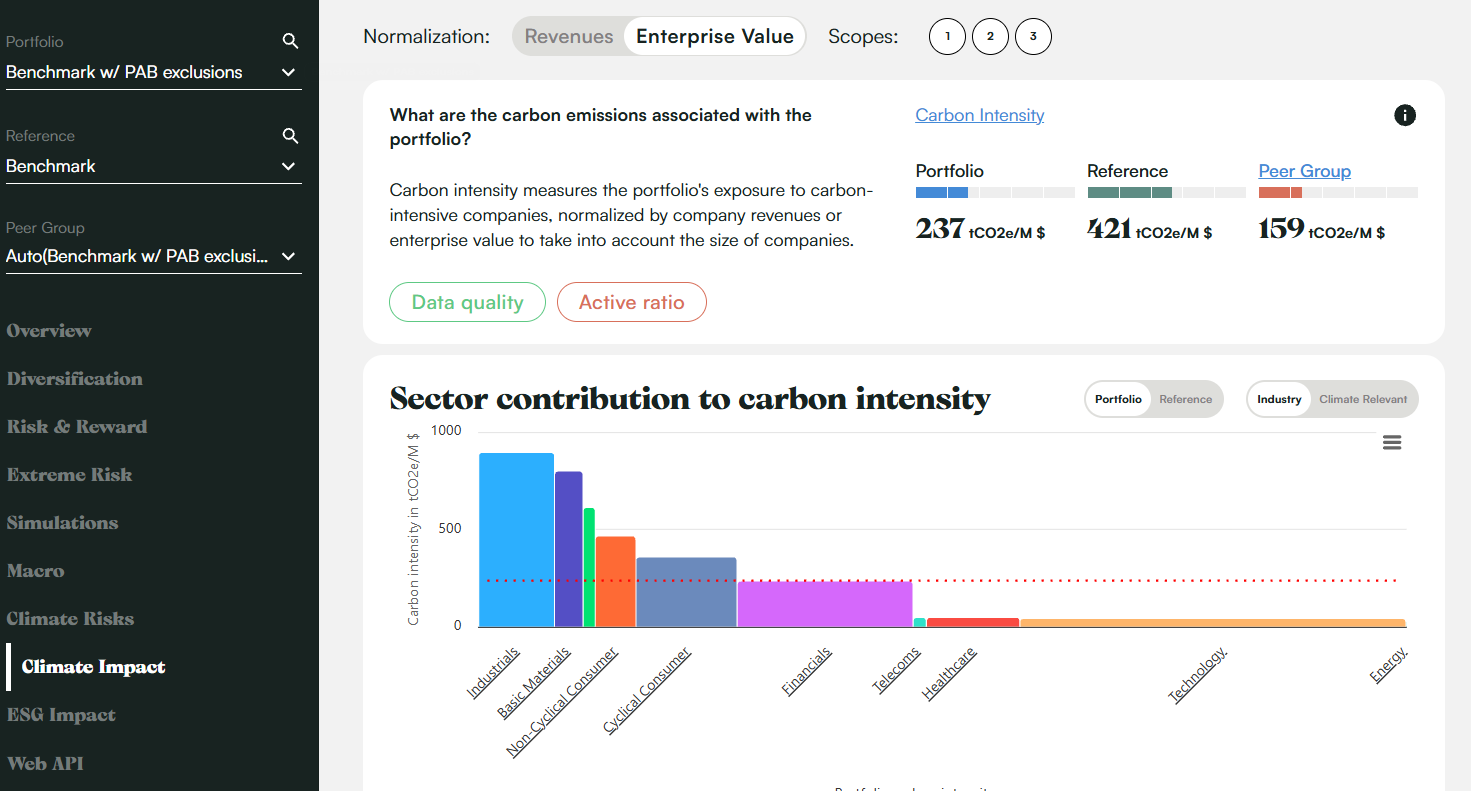
The other problem with the “50% rule” is the varying overlap with the hard exclusions rule described. Today, simply applying PAB-compliant exclusions to a global developed market cap-weighted benchmark generates a 44% reduction in carbon footprint, as shown below in Exhibit 1 (screenshot from SciX’s portfolio analytics platform). Continuing the argument above, the extent of this overlap may vary over time: improving corporate behavior could make it increasingly unrealistic to deliver the bulk of the required reduction through exclusions alone.
Exhibit 1: The effect of PAB exclusions on GHG intensity of a global developed benchmark
In practice, many investors have exercised a preference for climate transition benchmarks (CTB) versus Paris-Aligned Benchmarks, in part because the former has a less aggressive goal of 30% rather than 50%. Yet while the number may be less ambitious, it is similarly arbitrary.
A 7% annual reduction in portfolio-level carbon intensity—the trajectory prescribed for PAB and CTB products—compounds to approximately 52% over ten years…
This was an excerpt from Five Problems with PAB Climate Indices. To read the full article, download your free PDF copy via the form below.

"*" indicates required fields