Talk to SciX
Contact SciX to discuss climate indices, index requirements or disciplined customization.



Excerpt from How Much Tracking Error Does Climate Ambition Really Cost? To download the full article free of charge, please submit the form below
Institutional investors pursue climate-aware equity strategies for a variety of objectives. Some are mandated to decarbonise in line with the Paris Agreement; some seek to reduce climate transition risks or physical risks within the portfolio; some wish to contribute proactively to change by investing in companies that engage in climate solutions. Whatever the goal, one aspect is always present: investors must deviate from the benchmark, introducing tracking error for market participants whose risk budget is often explicitly defined in tracking error terms and intrinsically linked to fiduciary commitments.
Yet balancing the twin goals of tracking error and climate outcomes in live climate-aware equity portfolios (as opposed to convenient back-tests) is no easy task. An index adjusted to deliver a certain climate-related objective might have produced a particular average tracking error over a historic period, but the deviation could be very different going forwards. Conversely, portfolios that simply prioritise tracking error can leave climate goals under-achieved and ungovernable.
How can investors navigate this challenge? In this note, we compare two approaches: portfolio tilting, a methodology that is widely used across the climate indexation sector, versus using a risk model to target an ex-ante level of tracking error. (In the interests of making our bias transparent, the latter is the approach used by SciX indices.)
Key takeaways
The tilting approach is commonly applied in the investment industry to build climate equity strategies. Its attractions are obvious: it is a straightforward route to implement weight deviations from the reference benchmark that is both intuitive and simple to explain.
In a nutshell, companies with a good climate score are overweighted relative to their weight in the reference benchmark, while companies with a poor climate score are underweighted. The deviation from the market cap benchmark (and hence the tracking error) are driven by the climate score and the intensity of the tilt: the stronger the tilt, the bigger the tracking error. The tilt can be adjusted to ensure sector neutrality or region neutrality, though not both simultaneously. Imposing a sector or country constraint will, consequently, reduce the expected tracking error for a given tilt, while also reducing the climate ambition of the implemented strategy, as illustrated in Exhibit 1.
Exhibit 1: Average tracking error and climate physical loss reduction of climate-tilted strategies
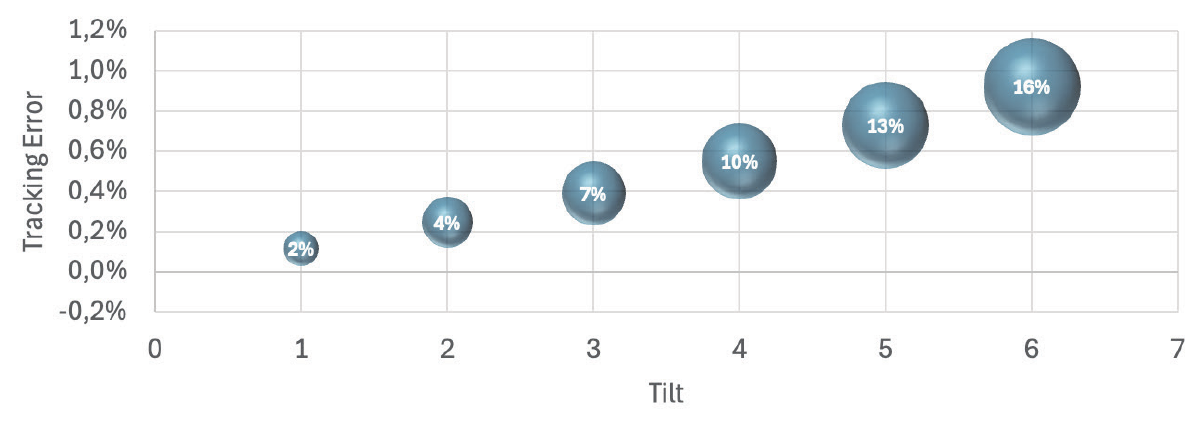
The choice of the tilt for an investor is then quite straightforward, in theory: the investor knows their tracking error budget and picks the tilt that corresponds to that number. For instance, a 0.5% tracking error budget would lead to the selection of the ‘tilt 4’ budget with an historical tracking error of 0.55%. Yet this simplicity and transparency hide two serious limitations.
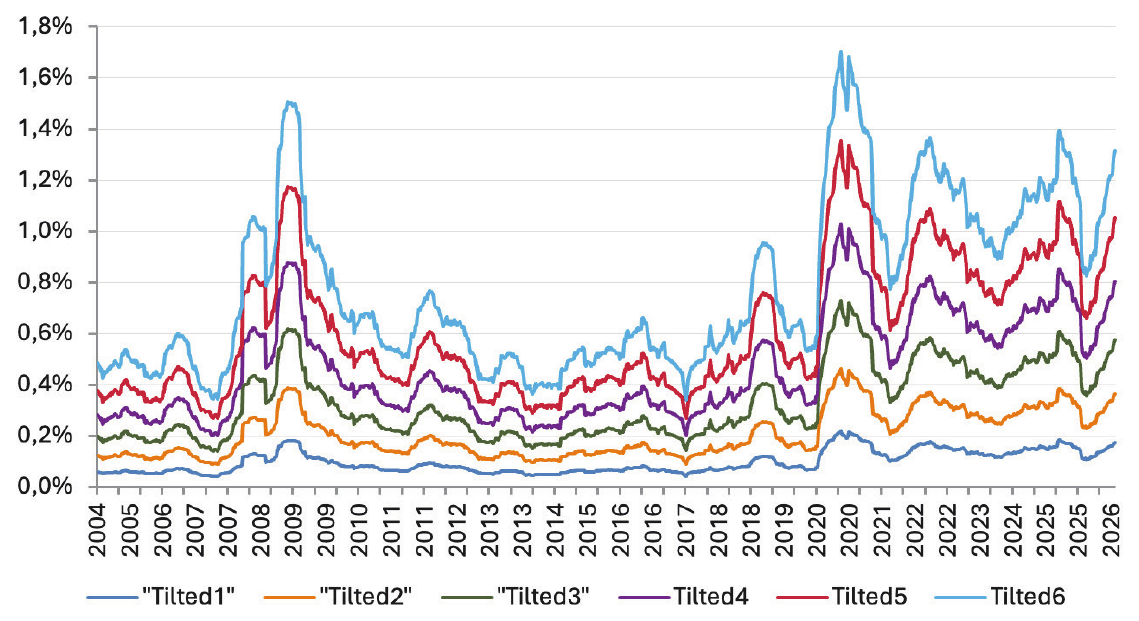
The first problem is that investors can end up over- or under-spending their tracking error budget for a long time after making their investment decision – especially amid shifts in market regime. Why? There is no reason to assume that historical tracking error implied by a given tilt is a good proxy for future tracking error. An investor making an investment decision in 2016 would have picked a different tilt than in 2026 or in 2008 to be in line with his risk budget. Advocates would argue that the intensity of the tilt defines the average weight deviation from the benchmark, or active share, which is a proxy for tracking error. Yet this argument assumes that active risk is homogeneous across stocks and across market conditions, which is not the case. As we see in Exhibit 2, the average tracking error can hide large short-term variations and different levels through time.
Exhibit 2: Six-month rolling tracking error for different climate tilted strategies
The second limitation of the tilting approach lies in its inefficiency in delivering investors’ climate objectives. Investors aim to maximize their climate goals, as measured by a climate score, per unit of active risk or tracking error. As such, they wish to consume their risk budget fully in order to pursue those climate deliverables. Indeed, in an ideal world, one could go even further on this aspect – as discussed below.
If tracking error matters, it should be managed – not assumed: by estimating the active risk of each stock ex-ante, a risk-model approach keeps the strategy closer to its tracking error budget. In our analysis, the climate risk-aware strategy achieved a physical climate loss reduction twice as high as the climate-tilted strategy for the same level of average historical tracking error, while the climate-tilted strategy consistently overshot its 0.5% risk budget by roughly 0.5% on average after 2020.
This was an excerpt from How Much Tracking Error Does Climate Ambition Really Cost? To read the full article, download your free PDF copy via the form below.

"*" indicates required fields