Talk to SciX
Contact SciX to discuss climate indices, index requirements or disciplined customization.



Excerpt from The Importance of Being Earnest About Risk Modelling in Climate Indices To download the full article free of charge, please submit the form below
In this third episode of our Risk Management Series, we focus on the concrete benefits of the SciX equity risk model for portfolio construction and risk management purposes when designing climate indices. We compare four approaches to building covariance matrices and test them to minimize the ex-ante tracking error of a climate-aware strategy.
Key takeaways
The short answer is that a risk model is required to effectively and dynamically manage the financial risk profile of diversified institutional equity portfolios. So any fiduciary investor subject to a risk budget will benefit from a risk model. The slightly longer answer goes back to the fundamentals of portfolio construction. Portfolio theory was developed to help investors access more efficient investment opportunities in the face of uncertainty. Efficiency is largely obtained thanks to the benefits of diversification, a risk mitigation technique often seen as the only free lunch in finance. However, as useful as diversification may be, it alone is not sufficient to construct a portfolio because some sources of common risk cannot be fully diversified away, as evidenced in Exhibit 1 for a hypothetical equity portfolio.
Exhibit 1: Variance of an equally weighted portfolio as a function of the number of stocks
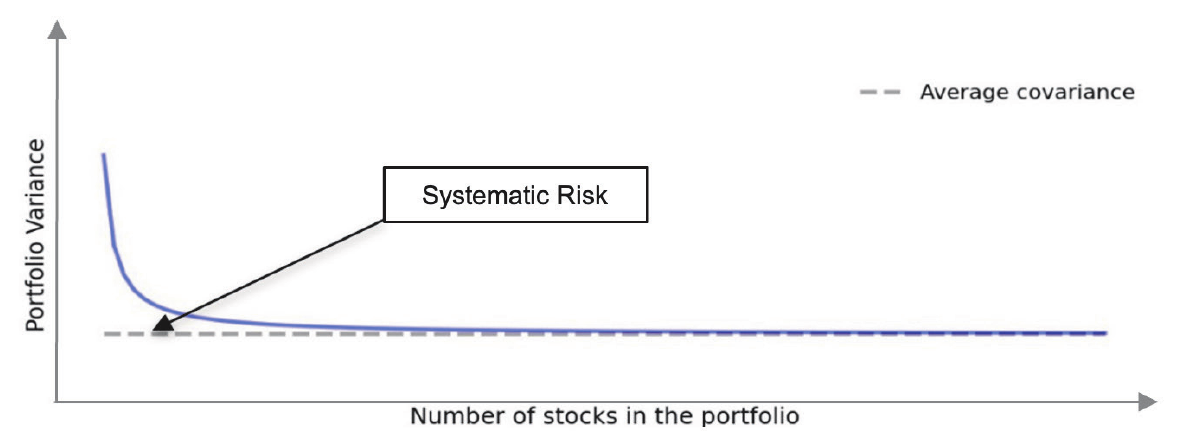
The level of the plateau reached in Exhibit 1 is, by design, the portion of equity risk that could not be entirely eliminated through diversification, also called systematic risk (as opposed to the idiosyncratic risk that is fully diversified away). It happens to be equal to the average covariance of returns, across every stock pair in the portfolio. Understanding the source and structure of covariance (i.e., volatilities and correlations) between stocks is therefore a prerequisite to identifying, quantifying and managing the (systematic) risks of diversified equity portfolios.
Equity risk modelling at its core is therefore an attempt to accurately estimate the covariance matrix of stock returns: the latter is then used in portfolio construction to measure the ex-ante risk of stocks and optimize portfolios that will respect investors’ risk budget. The covariance matrix could simply be estimated using high school algebra and a sample of historical stock returns. However, it has been well documented in academic literature that a large-scale sample covariance matrix is prone to estimation error due to the curse of dimensionality. As an illustration, for a portfolio of 500 stocks, the number of parameters that need to be estimated is 125,250, corresponding to the estimation of 500 volatilities and 124,750 correlations! Moreover, the sample covariance matrix is ill-conditioned, meaning that its inversion (required when solving for the optimal portfolio) is numerically unstable and its use in an optimizer will lead to the so-called “error maximization” problem, namely that the optimizer will overweight those risk estimates that are the most inaccurate. Consequently, the sample covariance matrix is a poor basis for building robust risk-aware equity portfolios.
Two main methods have been developed to overcome the shortcomings of the sample covariance matrix: shrinkage techniques and factor risk models. Shrinkage is a statistical technique designed to improve the properties of the sample covariance matrix by reducing the influence of estimation errors. This is achieved by optimally combining the sample covariance matrix with a target matrix that is less subject to estimation risk. For instance, the target matrix can be the identity matrix, which assumes that all stocks have the same volatilities and correlations.
Factor models seek to explain the cross-section of asset returns by distinguishing the portion of returns that are driven by systematic sources of risk to which stocks are collectively exposed, and the portion of returns that are specific to the stock itself. Consequently, the curse of dimensionality is significantly reduced as we only need to estimate stock exposures to the systematic risk factors to estimate the covariance matrix. There are three common types of factor models: i) statistical models, where both factors and factor exposures, i.e., betas, are assumed unobservable and need to be estimated, ii) fundamental time series models, which are popular with academics and where factors are assumed observable, such as the Fama-French factors, but not betas, and iii) fundamental cross-sectional models, used by popular risk engines in the industry and where betas are assumed observable but not factors.
Better risk forecasts, fewer surprises, controlled turnover: among the four risk models tested, the SciX risk model delivers the lowest realized tracking error and reduces forecast error by more than 25% versus PCA and Ledoit & Wolf during the Great Financial Crisis and Covid, with an average 1-way turnover of 33%, compared to 49% for PCA and 85% for Ledoit & Wolf.
This was an excerpt from The Importance of Being Earnest About Risk Modelling in Climate Indices. To read the full article, download your free PDF copy via the form below.

"*" indicates required fields